Artificial intelligence is transforming how people create, edit, and communicate information. From drafting emails to producing research papers and marketing content, AI-powered writing assistants have become valuable productivity tools for individuals and businesses alike.
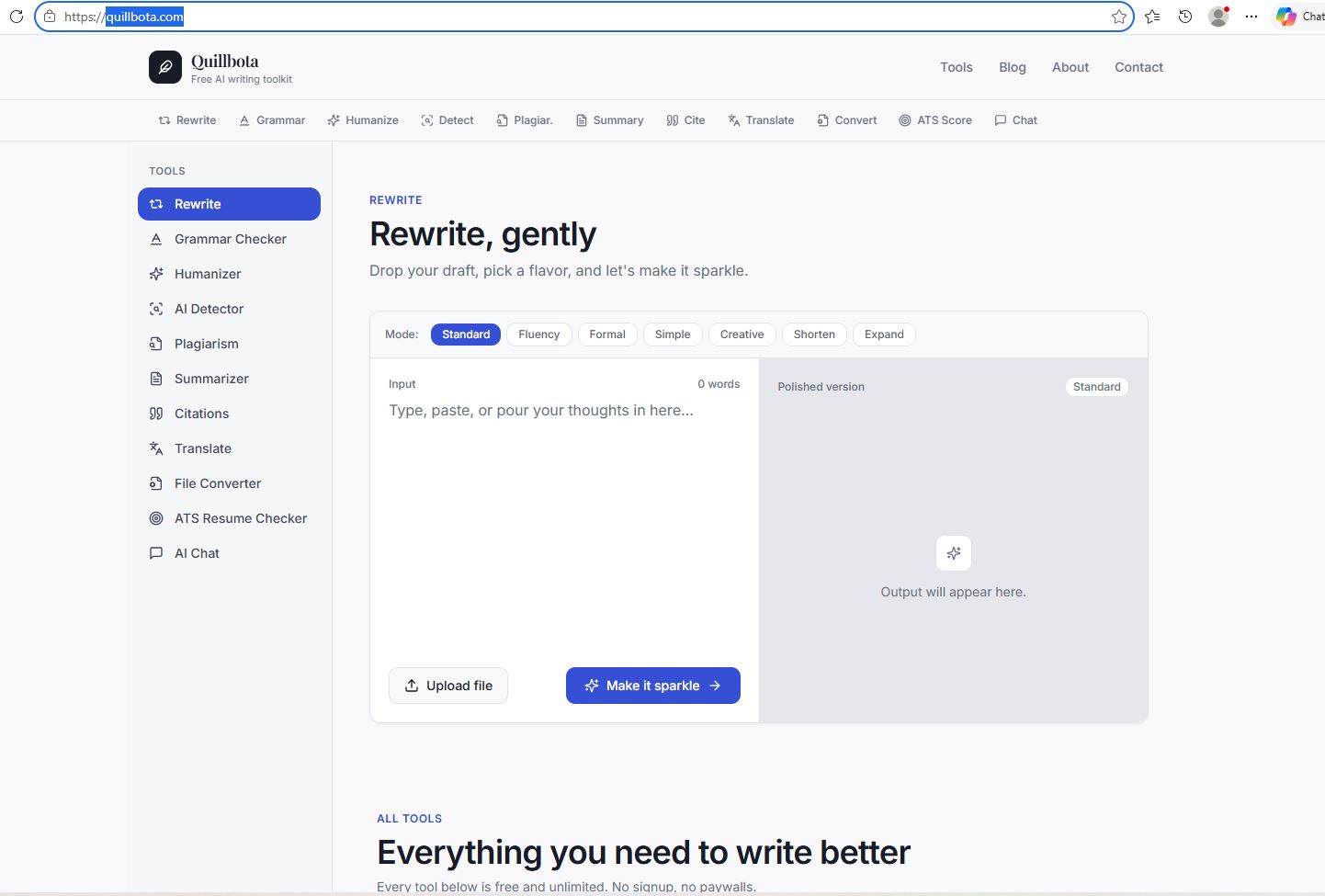
As someone passionate about artificial intelligence, software development, and data analytics, I wanted to better understand how modern large language models could be applied to solve real-world writing challenges. That curiosity led me to build QuillBota, an AI-powered writing assistant that serves as one of my personal software development projects.
Rather than simply experimenting with AI APIs, I wanted to design a complete web application that demonstrates how intelligent writing tools can improve productivity while keeping users in control of their content.
Why I Built the Project
Writing is an essential skill across nearly every profession.
Students write essays and research papers.
Business professionals prepare reports, proposals, and presentations.
Marketers create website content and advertising campaigns.
Researchers publish scientific findings.
Entrepreneurs communicate with customers and investors.
Although AI has made content generation significantly faster, creating high-quality writing still requires human judgment, creativity, and domain expertise.
I built QuillBota to explore how artificial intelligence can support that process by reducing repetitive work while allowing users to focus on ideas, accuracy, and communication.
Technical Goals
The project was designed to demonstrate several concepts in modern AI application development.
These include:
- Integrating large language models into a web application
- Building AI-assisted writing workflows
- Creating intuitive user interfaces
- Managing prompt engineering
- Processing natural language efficiently
- Developing scalable AI-powered software
- Improving user productivity through intelligent automation
The project also provided an opportunity to explore how AI can be incorporated into practical software products rather than existing solely as a research concept.
Features Explored
As the platform evolved, I implemented capabilities commonly found in modern AI writing assistants.
These include:
- AI-assisted content generation
- Text rewriting
- Grammar improvement
- Writing enhancement
- Tone adjustment
- Content summarization
- Idea generation
- Article drafting
- Business writing support
- Academic writing assistance
Each feature was developed to explore different aspects of natural language processing and user interaction.
Lessons Learned
Developing an AI application extends far beyond connecting an API to a website.
Building a useful platform requires careful attention to:
- User experience
- Prompt engineering
- Response quality
- System performance
- Scalability
- Cost optimization
- Security
- Responsible AI practices
One of the biggest lessons from this project is that AI performs best when it complements human expertise rather than replacing it.
Users still need to verify facts, exercise critical thinking, and apply their own knowledge to produce trustworthy content.
Continuous Development
Like many software projects, QuillBota continues to evolve.
Artificial intelligence is advancing rapidly, and each new generation of language models creates opportunities to improve writing assistance, personalization, and workflow automation.
Future development may include expanded editing capabilities, multilingual support, collaborative features, document organization, and additional AI-powered productivity tools.
Every iteration helps improve both the platform itself and my understanding of building intelligent software systems.
A Broader Vision
QuillBota is one of several projects I have developed that explore the practical application of artificial intelligence.
Across my work in healthcare analytics, educational technology, search engine optimization, and intelligent software systems, my goal remains consistent:
Build technology that solves meaningful problems and makes advanced AI more accessible to everyday users.
Each project strengthens my experience in designing, developing, and deploying real-world AI applications while contributing to a growing portfolio of practical innovations.
Explore the Project
QuillBota represents an ongoing exploration of AI-assisted writing and intelligent software development. While the project continues to evolve, it demonstrates how modern artificial intelligence can enhance writing workflows, improve productivity, and support better communication.
If you’re interested in AI applications, natural language processing, or software engineering, I invite you to explore the project and follow its continued development.
Project Website: https://quillbota.com
About the Author
Emmanuel Agbeko Enyo is a data analytics professional, AI researcher, and software developer with a passion for building intelligent systems that solve real-world problems. His portfolio includes projects spanning healthcare analytics, educational technology, search engine optimization, and AI-powered productivity tools. Through research and software development, he is committed to creating practical, data-driven solutions that improve decision-making, increase efficiency, and expand access to innovative technologies.